The Egypt oasis route is a 7 day loop through the Western Desert oases, and this is how it really runs
The Egypt oasis route is a 7 day loop through the Western Desert oases, and this is how it really runs
The Egypt oasis route is a road loop through the Western Desert oases that starts in Cairo and ends in Luxor. It runs south through Bahariya, the Black Desert and the White Desert to Farafra, on to Dakhla for the medieval mud town of Al Qasr and the Roman temple of Deir el Hagar, then to Kharga for the Persian temple of Hibis and the Christian necropolis of Bagawat, and finally east across the plateau to the Nile. It takes 6 to 8 days in a 4x4 with a driver who knows the tracks, one night camping among the chalk formations and the rest in oasis lodges. Siwa is a separate branch in the northwest.
What the Egypt oasis route actually is
Most of Egypt is not the Nile. The Western Desert covers about two thirds of the country, and scattered through it are five inhabited oases: Bahariya, Farafra, Dakhla, Kharga and Siwa. The first four sit roughly on a line running south from Cairo, joined by a paved road the government calls the New Valley. Driving that line, with detours off the asphalt into the Black and White Deserts, is the oasis route.
There are Roman temples and Coptic chapels along the way, but you come for the landscape: volcanic cones, wind carved chalk, pink escarpments over date palms, hot springs at the end of the day. The far end, Kharga, has a good road east to Luxor, so the loop finishes on the Nile instead of retracing 370 miles to Cairo.
The map: distances in miles and kilometers
The oases look close on a map and they are not. Every leg is a half day or more through country with no gas station and no cell signal. Figures are rounded, with the time our drivers plan on.
| Leg | Distance | Driving time |
|---|---|---|
| Cairo to Bahariya (Bawiti) | 225 mi / 365 km | 4 to 5 hours |
| Bahariya to Farafra via the White Desert | 110 mi / 180 km | A full day with the camp |
| Farafra to Dakhla (Mut) | 190 mi / 310 km | 4 to 5 hours |
| Dakhla to Kharga | 120 mi / 190 km | 2.5 to 3 hours |
| Kharga to Luxor | 175 mi / 280 km | 4 hours |
| Cairo to Siwa (separate branch) | 465 mi / 750 km | 9 to 10 hours |
The full loop from Cairo to Luxor is about 820 miles, or 1,325 km, of which perhaps 60 miles are off the asphalt.
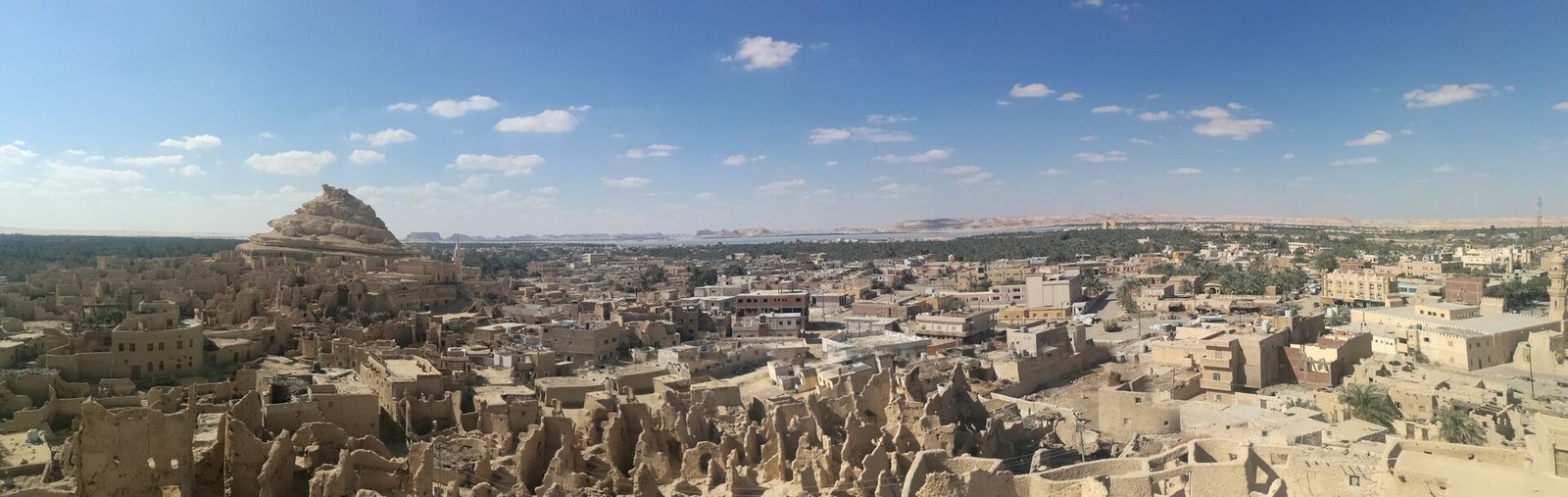
Bahariya, the gateway and the Black Desert
Bahariya is the oasis everybody reaches first, four hours southwest of Cairo. Its town, Bawiti, is where the drivers, the 4x4s and the camping gear live. It is not pretty, but what surrounds it is: dark hills, palm groves fed by hot springs, and a few sites worth two hours.
- The Golden Mummies, from a large Greco-Roman cemetery found under the desert here in the 1990s. A few are displayed in the small museum in Bawiti with their gilded masks.
- The tomb of Bannentiu and the temple of Alexander, a painted 26th Dynasty tomb and the only temple in Egypt that names Alexander the Great.
- The hot springs, Bir Sigam and others, where you sit at sunset and the trip stops feeling like a drive.
Half an hour south on the Farafra road the ground turns black. This is the Black Desert, a field of low cones capped with dark volcanic rock. You climb one, usually English Mountain, for the view over hundreds of them, and it is the first time the 4x4 leaves the road.
Farafra and the White Desert, the night you came for
Past the Black Desert the road climbs through a pass onto the plateau where the White Desert begins. The driver stops at Crystal Mountain, a roadside outcrop of quartz, then swings off the asphalt into Agabat, a valley of white cliffs, and threads between chalk formations until he picks a camp.
The formations are why this is a national park. Wind has eroded an old chalk sea floor into mushrooms, chickens and sphinxes, every shape the camp will argue about over tea. At sunset they go orange, under a full moon they are white as snow, and at dawn they are pink for ten minutes. You sleep in the open beside the vehicle. Our page on the White Desert of Egypt has the full camping detail.
Farafra, the next morning, is the smallest oasis: a mud brick village around an old fortress mound, the Badr Museum of a self taught sculptor, and the Bir Sitta hot spring where you wash off the night.
Dakhla: Al Qasr and Deir el Hagar
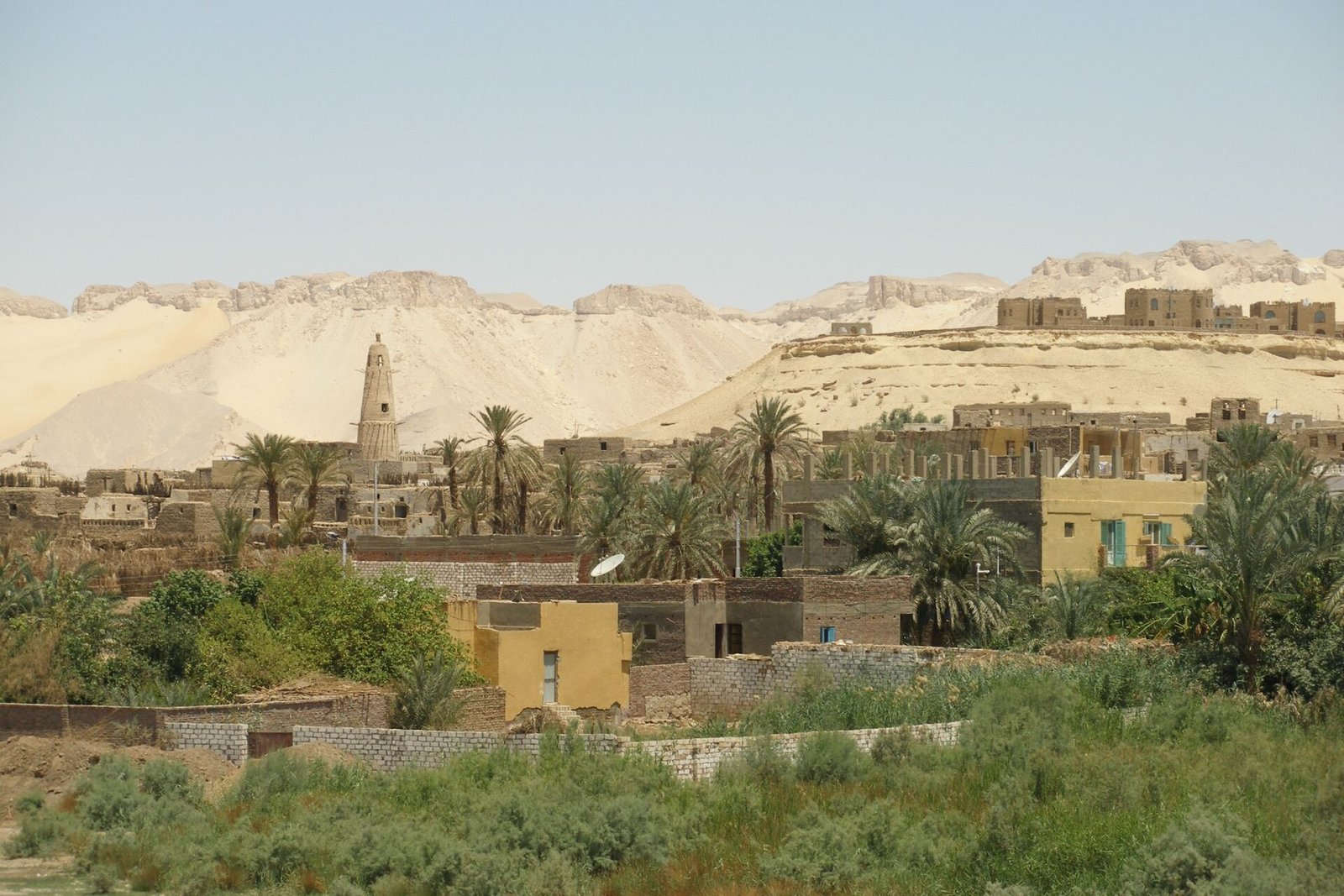
Dakhla is the oasis people fall in love with. It sits under a long pink escarpment, its villages are spread through miles of palm groves, and it holds two of the least visited great sites in Egypt.
Al Qasr is a medieval Islamic town founded in the Ayyubid period on Roman foundations and lived in until the last generation. Its lanes are covered, so you walk in shade under acacia beams; the doorways carry carved lintels naming the families who built them; the Nasr el Din minaret still stands; and a restored mill, courthouse and oil press show how the town worked. A caretaker leads you through in an hour and a half.
Deir el Hagar, a few miles west, is a Roman temple to Amun, Mut and Khonsu begun under Nero. Sand buried it for centuries, which is why the reliefs are so crisp. Nearby, the Muzawaka tombs have Roman era painted ceilings of the zodiac and Egyptian gods dressed as Romans. Add a soak at Bir el Gebel and a sunset on the dunes, and Dakhla earns its full day.
Kharga: Hibis, Bagawat and the road to Luxor
Kharga is the largest oasis and the capital of the New Valley, a modern town of wide streets. You come for two monuments and the exit road.
The temple of Hibis, north of town among the palms, is the best preserved Persian period temple in Egypt, built mainly under Darius I in the sixth century BC and finished by the Ptolemies. The reliefs include a famous image of the god Seth as a winged figure spearing the serpent Apophis.
Up the hill is Bagawat, a Christian necropolis of several hundred mud brick chapels from the fourth to sixth centuries, the largest early Christian cemetery of its kind. A few keep their painted domes, with Adam and Eve, Noah's ark and the Israelites crossing the Red Sea.
Then the vehicle turns east. The Kharga to Luxor road climbs onto the plateau, runs four hours through nothing and drops into the Nile valley near Armant. Arriving at the river after a week of desert is a strong feeling, and the next day you have everything there is to see in Luxor.
Siwa, the separate northern branch
Siwa is a Western Desert oasis too, but it is not on the loop. It lies in the far northwest, about 30 miles from the Libyan border, reached from Cairo by the coast through Alexandria or Marsa Matruh in nine to ten hours. A desert track links Bahariya and Siwa across 260 miles of sand, but it needs permits that are granted irregularly, so Siwa is its own three or four day trip out of Cairo.
The people are Amazigh and speak Siwi at home, the old town of Shali is a salt and mud fortress you climb at sunset, the oracle of Amun is where Alexander the Great came in 331 BC, and the salt lakes are so dense you float without trying. Our Siwa oasis guide covers it on its own. With three weeks in Egypt you can do both, and our Egypt in 3 weeks itinerary shows where the desert fits around the Nile and the Red Sea.
A 7 day day by day, with the 6 and 8 day versions
This is the shape we run most often, starting from Cairo and finishing on the Nile.
- Day 1, Cairo to Bahariya. Leave early, arrive for lunch. Golden Mummies museum, Bannentiu tomb, hot spring at sunset. Lodge in Bawiti.
- Day 2, Bahariya to the White Desert. Black Desert, Crystal Mountain, Agabat, camp among the chalk formations.
- Day 3, White Desert to Dakhla. Sunrise in camp, Farafra for the museum and a spring, long afternoon drive. Ecolodge under the escarpment.
- Day 4, Dakhla. Al Qasr in the morning, Deir el Hagar and Muzawaka after lunch, the dunes at sunset. Second night in Dakhla.
- Day 5, Dakhla to Kharga. Balat and the Old Kingdom mastabas at Qila el Dabba on the way, afternoon at Hibis and Bagawat.
- Day 6, Kharga to Luxor. The plateau road to the Nile, arrive mid afternoon, Luxor Temple at dusk.
- Day 7, Luxor. Valley of the Kings and the west bank, or Karnak. Fly or train onward.
The 6 day version drops the second Dakhla night, and Dakhla is where you will wish you had lingered. The 8 day version adds a night in Farafra, which breaks the longest driving day in two. With only three days, do Bahariya and the White Desert camp and back to Cairo; the Fayoum oasis is the one day alternative.
The 4x4, the driver and the checkpoints
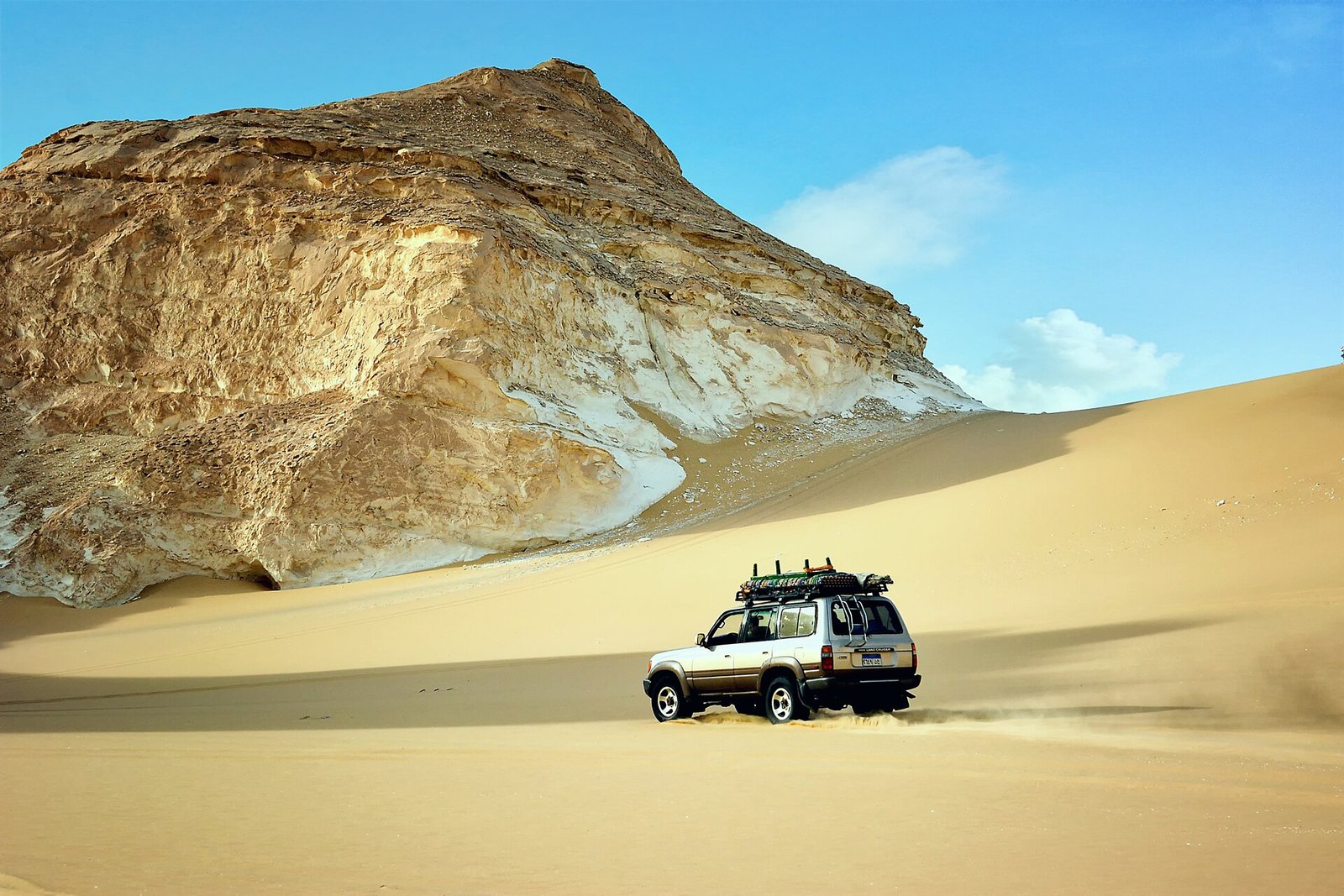
The vehicle is a Toyota Land Cruiser or something very like it, carrying up to four passengers with the camping gear on the roof. On the paved legs a minibus would do, but the Black Desert, Agabat, the White Desert and the dunes around Dakhla need low range and a driver who reads sand. The same 4x4 and driver take you from Cairo to Luxor.
The driver matters more than the vehicle. A good one knows where the soft sand is this season, which camp spot is out of the wind, how to fix a puncture in the dark, and every checkpoint officer by name. He also cooks.
Checkpoints are a normal part of driving the Western Desert. There is one at the edge of every oasis and at the main junctions, and they log foreign travelers passing through. Your driver hands over a paper with your names and passport numbers and you are waved on. Some deeper tracks need a permit arranged in advance, which is our job, and the rules change without notice. Keep your passport in the vehicle every day. Do not rent a car in Cairo and try this yourself; with the right people the desert is entirely safe, and without them it is not.
Where you sleep and what you eat
The route mixes two kinds of nights. The camp. One night, sometimes two, in the White Desert. The crew sets a windbreak, lays out mattresses and sleeping bags, and cooks on a fire. There is no tent unless you ask, no bathroom, no shower, and the temperature falls hard after midnight even in a warm month. In exchange you get the cleanest sky most people will ever see and a silence you can hear.
The lodges. In Bahariya, Dakhla and Kharga you sleep in small ecolodges of mud brick and palm beam, with private bathrooms and hot water from a spring. Simple and clean, not luxurious. There is no five star hotel anywhere on the route.
Food in camp is chicken or vegetables with rice, salad, flatbread and sweet Bedouin tea, all cooked on the fire, and better than it sounds. Tell us about allergies and diets before you go, because in the middle of the White Desert there is no plan B.
When to go: the seasons in Fahrenheit and Celsius
The oasis route is a fall, winter and spring trip. Most operators do not run the White Desert camp from June to early September.
| Months | Daytime | Night in the White Desert | Verdict |
|---|---|---|---|
| October and November | 77 to 86 F / 25 to 30 C | 50 to 59 F / 10 to 15 C | The best window |
| December to February | 64 to 72 F / 18 to 22 C | 36 to 45 F / 2 to 7 C | Superb light, cold camp |
| March and April | 75 to 90 F / 24 to 32 C | 50 to 61 F / 10 to 16 C | Good, occasional sandstorm |
| May to September | 95 to 110 F / 35 to 43 C | 64 to 82 F / 18 to 28 C | Avoid, camps mostly closed |
Desert nights are always 30 to 40 degrees Fahrenheit colder than the day. A winter camp needs a real jacket, a hat and socks to sleep in. For how the desert lines up with the Nile and the Red Sea, see the best time to visit Egypt.
What to pack for the desert legs
A warm layer and a windproof shell whatever the month, a scarf for sand in the wind, sunscreen, a headlamp, a power bank and a swimsuit for the springs. The full list is on what to pack for Egypt.
Who the oasis route suits, and who should skip it
It suits travelers on a second trip to Egypt, or a long first one, who want the country nobody at home has seen. It suits photographers, couples who want a night under the stars, and anyone the tour bus circuit exhausts. Fit adults of any age do fine; the walking is short.
It does not suit people who need an elevator hotel every night, anyone for whom sleeping on the ground is a problem, families with children under about eight, or a first timer with one week who has not seen the Nile. The Nile is Egypt's history, the oases are its geography. If the word that draws you is monuments, do the river. If it is landscape, do the loop.
How Explora Egipto runs the oasis route
We are a local agency in Egypt with our own guides and vehicles, and this is what running the loop properly means to us:
- Private from the first day. Your own 4x4, Bedouin driver and guide from Cairo to Luxor. No mixing with other groups, no swapping drivers at Bahariya.
- Every permit and checkpoint list prepared before you leave.
- Lodges chosen for the spring, the food and the owner.
- A proper camp, with thick mattresses, clean sleeping bags, blankets for the cold hours and a tent if you want one.
- The Luxor exit, with your Nile days or a domestic flight back to Cairo in the same plan.
Tell us how many days you have and whether you want Siwa too, and we send you the day by day and the quote.
Frequently asked questions
How many days does the Egypt oasis route take?
Seven days from Cairo to Luxor is the comfortable standard: one night in Bahariya, one camping in the White Desert, two in Dakhla, one in Kharga, then the drive to Luxor. Six days works if Dakhla gets a single night, and three days gets you Bahariya and the White Desert only.
Can I do the oasis route without a 4x4?
The paved legs could be driven in any car, but the parts you are coming for, the Black Desert, Agabat, the White Desert camp and the dunes around Dakhla, are sand and rock track that need a 4x4 and a driver who knows them. There is no signal for hours at a time and some tracks need permits.
Is Siwa part of the Egypt oasis route?
Siwa is a Western Desert oasis but it is not on the loop. It is in the far northwest near Libya, reached from Cairo by the coast in nine to ten hours, and the desert track from Bahariya needs permits that are rarely given. Treat it as a separate three or four day trip from Cairo.
What are the checkpoints like on the oasis route?
There is one at the entrance to each oasis and at the main junctions. Your driver hands over a list with your names and passport numbers and you continue, usually within a couple of minutes. Foreign travelers are logged, not questioned. Keep your passport in the vehicle every day, and leave the permits to your operator.
When is the best time of year for the Western Desert oases?
October to April. October and November give warm days around 77 to 86 F (25 to 30 C) and mild nights. December to February has the clearest light but the White Desert camp can drop to near freezing, so pack a real jacket. March and April are good with an occasional sandstorm. Summer is too hot and most camps do not run.
Is the oasis route safe for American travelers?
Yes, when done with a local operator, a licensed driver and the permits in order. The oases are quiet farming towns, and the real risks are the ordinary desert ones: heat, cold at night and vehicle trouble far from help. Those are managed by the vehicle, the driver and the planning.
See the Egypt almost nobody sees
Send us your dates and how many days you can give the desert, and we come back with a day by day for the oasis route from Cairo to Luxor, with the 4x4, the driver, the guide and every night arranged, plus the quote.